

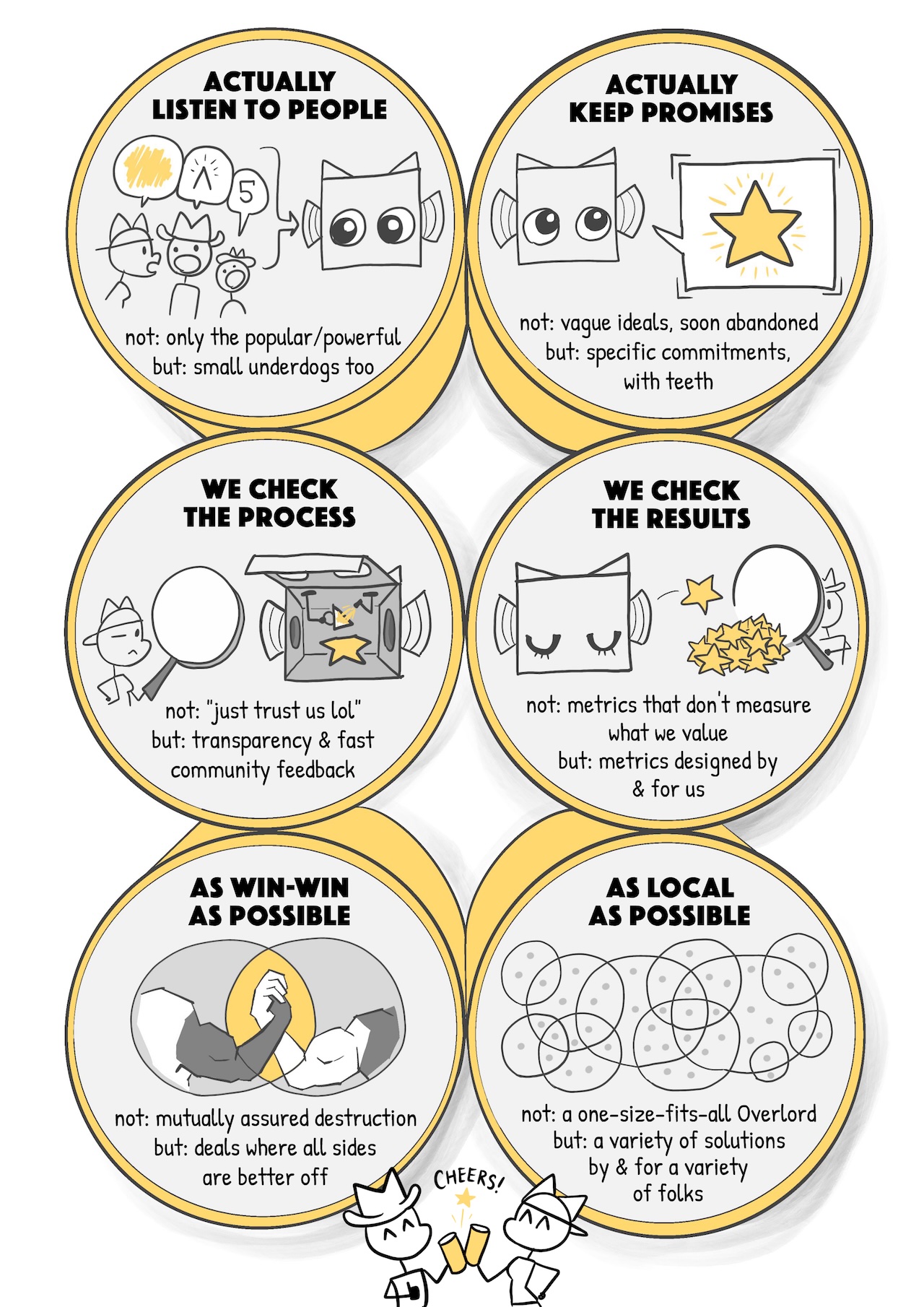
Civic AI is alignment by public process: community-authored safeguards, public accountability, and bounded local systems.
Most AI alignment work tries to solve values from the top down: write better rules, infer better preferences, train better models. Those tools matter. They are not enough on their own.
The 6-Pack starts somewhere else. It asks who gets heard, who is accountable, how failures are repaired, and when a system should stop. Alignment is not solved once. It is maintained in public.
The 6-Pack treats AI not as a universal governor but as a bounded local steward, or Kami: specific to a place, open to challenge, and easy to hand off or retire.
Start here
- Policy. Read the Manifesto, the FAQ, and "AI Alignment Cannot Be Top-Down".
- Engineering. Start with Pack 3: Competence, Measures, and "Inside the Kami".
- Civic practice. Start with Pack 1: Attentiveness, Pack 4: Responsiveness, and Podcast: The 6-Pack of Care.
The 6-Pack
Six design principles translate care ethics into something institutions can build and inspect:
- Pack 1: Attentiveness — what the people closest to the problem are seeing that institutions still miss.
- Pack 2: Responsibility — who is accountable, with what authority, and what happens if they fail.
- Pack 3: Competence — whether the system actually works in practice: audited, explainable, and safe to fail.
- Pack 4: Responsiveness — whether affected people can contest outcomes and force repair.
- Pack 5: Solidarity — whether the ecosystem rewards cooperation, exit, and public accountability over lock-in.
- Pack 6: Symbiosis — whether the system stays bounded, local, and sunset-ready instead of hardening into permanent rule.
- Measures — one headline public measure per pack, with supporting diagnostics.
Three proof points
- A public-policy case. "AI Alignment Cannot Be Top-Down" shows how Taiwan used an Alignment Assembly to respond to AI-enabled scam ads.
- A technical case. "Inside the Kami" argues that bounded, specialised systems are easier to govern than general-purpose agents.
- A civic-practice case. "Ciudadanía Digital" and Podcast: AI and Democracy show how this work connects to participation, legitimacy, and everyday public problem-solving.
Publications
- "Sunset Section 230 and Unleash the First Amendment": Audrey, Jaron Lanier, and Allison Stanger argue for ending algorithmic amplification's liability shield while protecting human speech — the reach-not-speech reform at the heart of Pack 5. (Communications of the ACM, January 2026)
- "How Malicious AI Swarms Can Threaten Democracy": Audrey joins Maria Ressa, Nick Bostrom, Nicholas Christakis, and 19 other researchers to document how LLM-powered agent swarms can infiltrate communities and fabricate consensus at population scale. (Science, 2026)
- "Conversation Networks": Audrey, Deb Roy, and Lawrence Lessig propose civic communication infrastructure — interoperable apps with Civic AI guided by communities — as the technical layer beneath 6-Pack of Care. (McGill Centre for Media, Technology and Democracy, March 2025)
- "Community by Design": Audrey and Glen Weyl with four co-authors propose rebuilding social platforms around social fabric — rewarding content that bridges communities rather than maximising engagement. The technical backbone behind Packs 1 and 5. (arXiv, February 2025)
Project


The project sits between a manifesto, a set of operational pack pages, and a book arriving in 2026. Audrey Tang and Caroline Green will present the framework at the Civic AI Conference on 25 March 2026.